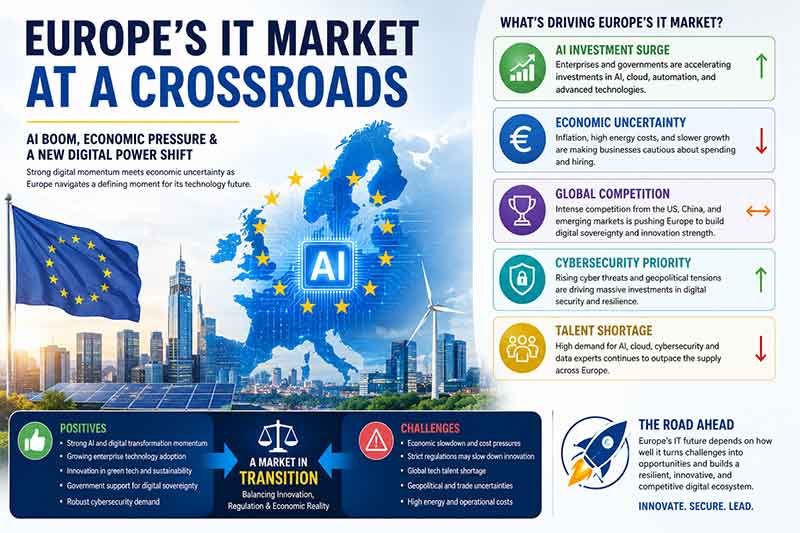




From Artificial Intelligence investments to economic uncertainty, Europe’s technology sector is entering one of its most transformative periods in decades.
Europe’s information technology market is witnessing a complex mix of optimism and uncertainty as governments, corporations, and startups accelerate investments in Artificial Intelligence, cloud infrastructure, cybersecurity, and digital transformation while also facing economic slowdown concerns, regulatory pressure, and global competition.
Across major European economies including Germany, France, the United Kingdom, the Netherlands, and the Nordic region, businesses are rapidly adopting AI-powered systems to modernize operations and improve productivity. However, rising operational costs, geopolitical instability, talent shortages, and strict technology regulations are creating fresh challenges for the region’s IT industry.
Industry experts describe the current European technology atmosphere as “cautiously positive” — driven by strong long-term digital demand but shadowed by short-term economic and structural pressures.
AI Investment Surge Driving Optimism
Artificial Intelligence has become the biggest growth engine for Europe’s technology market.
Governments and enterprises across Europe are increasing spending on:
- Generative AI
- Automation systems
- Cloud computing
- Semiconductor technologies
- Cybersecurity infrastructure
- Smart manufacturing
- Green technology platforms
European companies are increasingly integrating AI into banking, healthcare, logistics, automotive, retail, and industrial sectors to improve efficiency and reduce operational costs.
The rapid growth of AI startups and enterprise AI adoption is helping Europe remain competitive in the global digital economy despite intense pressure from the United States and China.
Technology analysts believe AI could become Europe’s next major industrial revolution, especially in advanced manufacturing and enterprise automation.
Economic Slowdown Creating Uncertainty
Despite the optimism around AI and digital transformation, Europe’s broader economic conditions continue to affect the IT market.
Several businesses are becoming cautious about:
- Large-scale hiring
- Long-term IT spending
- Expansion projects
- Venture capital investments
High inflation in parts of Europe, energy price volatility, and slower economic growth have forced many companies to prioritize cost optimization over aggressive expansion.
Some technology firms have delayed projects or reduced workforce growth as clients reassess budgets and operational expenses.
The uncertainty has created a mixed atmosphere where digital transformation remains essential, but spending decisions are becoming more selective.
Europe Faces Intense Global Competition
Europe is also under pressure from rapidly growing technology ecosystems in the United States, India, China, and the Middle East.
American AI giants continue to dominate global cloud and AI infrastructure, while Asian markets are scaling technology manufacturing and software innovation at extraordinary speed.
To remain competitive, European nations are focusing on:
- Sovereign AI initiatives
- Local semiconductor production
- Digital independence
- Data protection frameworks
- Green technology innovation
The region’s strict technology regulations, especially around AI governance and data privacy, are being viewed both as a strength and a challenge.
Supporters argue that Europe’s regulatory approach can build trusted and ethical AI systems, while critics warn that excessive regulation may slow innovation and startup growth.
Cybersecurity and Digital Defense Become Priority
The growing number of cyber threats and geopolitical tensions has significantly increased demand for cybersecurity services across Europe.
Governments and enterprises are investing heavily in:
- Data protection
- Critical infrastructure security
- AI-powered cyber defense
- Digital resilience systems
As digital dependence increases, cybersecurity is expected to become one of Europe’s fastest-growing IT sectors over the next decade.
Experts believe the region’s focus on secure digital infrastructure could create major opportunities for technology companies and skilled professionals.
Talent Shortage Remains a Major Challenge
Europe’s IT sector is also facing an increasing shortage of highly skilled technology professionals.
Companies are actively searching for experts in:
- Artificial Intelligence
- Cloud Engineering
- Cybersecurity
- Data Science
- Automation
- Semiconductor design
The shortage is pushing businesses to recruit internationally while also investing in reskilling and workforce development programs.
Competition for high-end AI and engineering talent has intensified across major European technology hubs.
A Market Balancing Growth and Pressure
Industry observers say Europe’s IT market is not entering a crisis — but rather a major transition phase.
The region continues to show strong long-term digital potential due to:
- High enterprise technology adoption
- Strong industrial base
- Advanced infrastructure
- Government-backed innovation programs
- Sustainability-focused technology investments
However, success will depend on how effectively Europe balances innovation, regulation, economic stability, and global competitiveness in the rapidly evolving AI era.
Final Analysis
Europe’s technology atmosphere today is neither fully negative nor completely optimistic.
Instead, the region stands in a high-stakes transition period where Artificial Intelligence, cybersecurity, digital sovereignty, and economic realities are reshaping the future of the IT industry.
The next few years could determine whether Europe emerges as a trusted global leader in ethical AI and advanced digital infrastructure — or struggles to keep pace with faster-moving global technology powers.